One asset class that is gaining traction within retail investors but whose nuances are are yet to be completely understood is Real Estate Investment Trusts (“REITs”). Before we understand this asset class, one needs to understand the backdrop and the reason for the growth of this asset class in India.
Background:
Thanks for reading WealthYatra's Newsletter! Subscribe for free to receive new posts and support my work.
One big event which transformed the real estate market in India was Demonetization in November of 2016. Demonetization significantly transformed the real estate sector from an unorganized, cash-heavy market to a more transparent, organized industry. Pre demonetization – cash was a critical component of real estate sales and the sector served to some extent as a conduit to illegal money which artificially inflated prices.
Post-demonetisation and the implementation of The Real Estate Regulation and Development Act (RERA), Indian real estate fundamentally transformed from a high-cash, opaque sector into a regulated, transparent, and developer-branded market. RERA, which was implemented in 2017, is a landmark legislation in India designed to regulate the real estate sector. RERA mandates project registration, escrow accounts for funds, and disclosure of plans, which drastically increased buyer confidence, especially in the residential segment.
What exactly are REITs:
Here is a quick overview of REITs:
REITs allow investors to access the benefits of investing in real estate through a publicly traded unit
REITs own, operate and/or manage income or rent generating real estate assets
REITs are tax efficient vehicles that are required to distribute at least 90% of their cash flows to the unitholders, at least semi-annually
REITs provide distribution yields with in-built capital appreciation potential
REITs are heavily regulated by SEBI and exhibit high levels of disclosure, transparency, and corporate governance
REITs in India are permitted to own real estate, such as offices, retail, among others. They are not permitted to own speculative landbanks
Indian REITs can only own assets situated in India
Indian REITs must have at least 80% (by value) of their assets completed and income or rent generating; the remaining 20% can be invested in under-construction assets and certain other investment instruments
Post IPO, REIT units are listed & traded on stock exchanges – NSE and BSE like equity shares
Any eligible investor (domestic / foreign / retail / institutional) can buy REIT units in India
The REIT units can be bought or sold through a demat account, and the process is similar to the buying or selling of an equity share of a listed company
An investor can buy or sell a single unit at a time
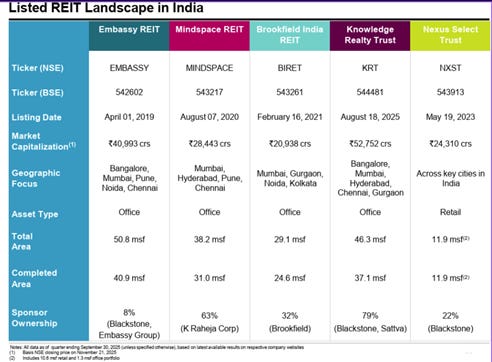
There are 5 REITs listed in India currently – Embassy REIT, Mindspace REIT, Brookfield India Trust, Nexus Select Trust and Knowledge Realty Trust (in the order of listing)
The 5 REITs have a substantial ₹2.4 lakh crores in gross Assets Under Management (AUM), combined market cap of over ₹1.6 lakh crores and a portfolio of over 175 million square feet of Grade A commercial and retail spaces nationwide (Data as of September 30, 2025)
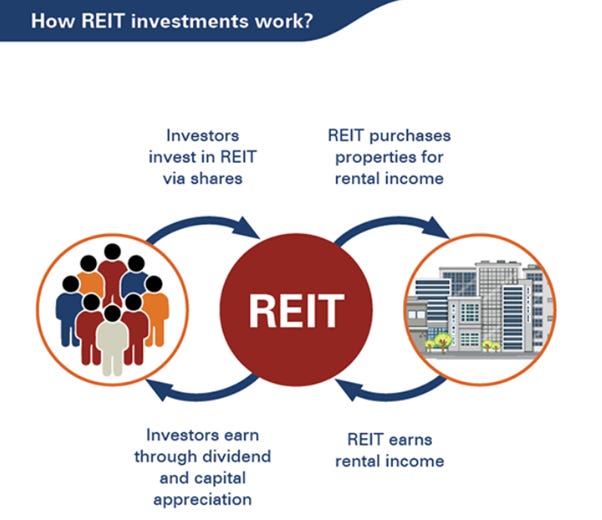
Investors in Indian REITs generate returns primarily through consistent dividend income (rental payouts) and capital appreciation (unit price increases).
On February 6, 2026, the Reserve Bank of India announced plans to boost financing for the real estate sector by allowing banks to lend to REITs provided they follow certain prudential safeguards. This means that banks can now extend loans to REITs, which can help reduce their borrowing costs, ultimately benefiting REIT investors with higher dividends and returns on their investment.
How REITs work:
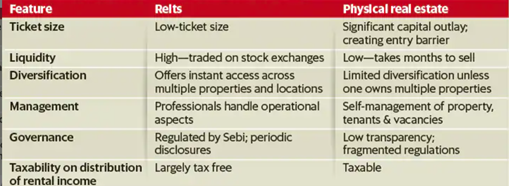
How do REITs compare to an investmet in Physical Real Estate:
Listed REITs in India:
In comparison, there are over 1,100 U.S. REITs that file tax returns, with more than 225 publicly traded REITs registered with the SEC and listed on major stock exchanges. These public REITs own approximately $2.5 trillion in gross assets, representing a diverse portfolio of over 570,000 properties across the U.S.
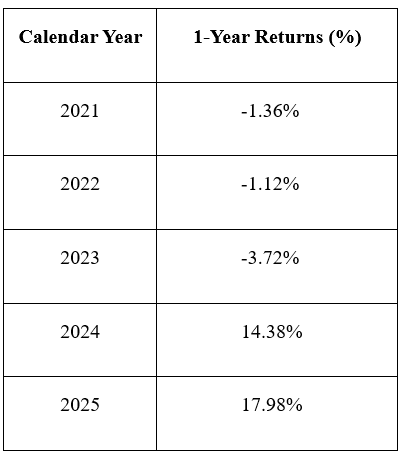
Returns:
The total returns of Embassy Office Parks for the last few years are shown below. Although the past returns are not indicative of the future, one needs to consider the potential growth of the commercial real estate market in India in the coming decade
Source: Embassy REITs Investor Presentation and Trendlyne
Should REITs be part of an asset allocation:
Indian real estate which was predominantly dominated by residential properties in 2020 has undergone a sea change due to the significant growth of commercial real estate. Commercial Real Estate is no longer a fringe business and has become a major force in the Indian economy. India Commercial Real Estate market is projected to grow at a CAGR of 9.70% between 2025 and 2034, reaching a value of USD 860.2 billion by 2035.
Global Capability Centers (GCCs) are driving the demand for office space. NASSCOM estimates show that India has more than 1,900 GCCs. The sector may contribute around $60 billion by the end of 2026
The Warehousing Boom: Driven by “Quick Commerce - Platforms like Blinkit and Zepto need small warehouses inside cities. This has increased demand for urban storage spaces. As a result, commercial land in city outskirts is turning into logistics hubs.
PLI schemes of the Govt: With the Atmanirbhar theme driven by the Govt of India to turn India into a manufacturing powerhouse, demand for industrial parks across the country for EVs, electronics, defence equipments, textiles etc are on the rise.
Growth of Tier-2 cities: Major metros Metro like Mumbai and Bengaluru are becoming expensive forcing companies to move to Tier 2 cities like Ahmedabad, Kochi, and Chandigarh offer 25–30% lower operating costs.
REITs offer an excellent opportunity to leverage this growth of commerical real estate in India.
What to look for while evaluating REITs:
Occupancy and location: Occupancy is the most reliable single metric for evaluating REIT quality. High, consistent occupancy signals better asset quality, location premium and management strength. Location quality is another factor which makes high occupancy sustainable over the long run
Debt Levels and Interest rates: REITs own massive amounts of land and properties and therefore borrow money to acquire and develop such properties. The Indian market regulator has capped leverage for REITs at 49% of their total asset value. Historically REITs with low debt and low-Loan to Value levels have performed well. REITs borrow heavily, so when the RBI raises lending rates, REITs with less loans benefit more because a bigger share of their income stays as profits. That is why keeping a close watch on rate cycles is important for REIT investors.
Lease Structure and Expiry - A REIT with long-dated, escalating leases is structurally superior to one facing near-term expiries. Lease expiry schedules are disclosed in quarterly investor presentations and are worth reading carefully before investing.
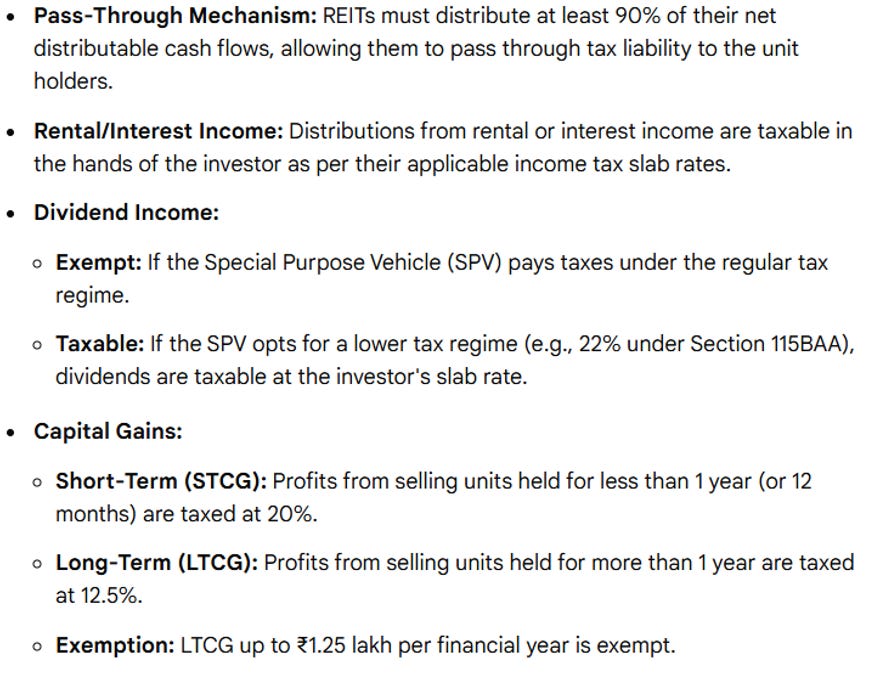
Key components of REIT Taxation in India (FY 2025-26):
Potential Risks with REITs:
Concentration/Business Risk: Many Indian REITs have heavy exposure to commercial office spaces. If a REIT portfolio is concentrated in a few properties or clients, a single tenant departing (tenant concentration) or localized downturns (regional risk) can hurt cash flows.
Interest Rate Sensitivity: When interest rates rise, REIT prices often fall, as they become less attractive compared to fixed-income investments. Higher rates can also increase borrowing costs for REITs, reducing the distribution amount to investors.
Market Volatility and Liquidity: Although listed, REIT units can be volatile, fluctuating based on market sentiment. Some REITs may suffer from lower trading volumes, making it hard to exit at the desired price.
Summary:
Investing in Indian REITs offers a high-yield, liquid, and regulated pathway to the growing commercial real estate market in India, providing diversification from other asset classes with steady, quarterly income distributions. They offer investors access to prime, professionally managed, rent-generating assets (offices, malls) with a potential 11-13% total return through income and capital appreciation.
Disclaimer: Information and data provided in this write up is sourced from publicly available information and Investor resources of publicly listed REITs. The information provided is for educational or informational purposes and does not professional investment advice. Wealth Yatra is not responsible for the accuracy or content of external websites from which the information is sourced.
Thanks for reading WealthYatra's Newsletter! Subscribe for free to receive new posts and support my work.